A signed identity that can't be faked
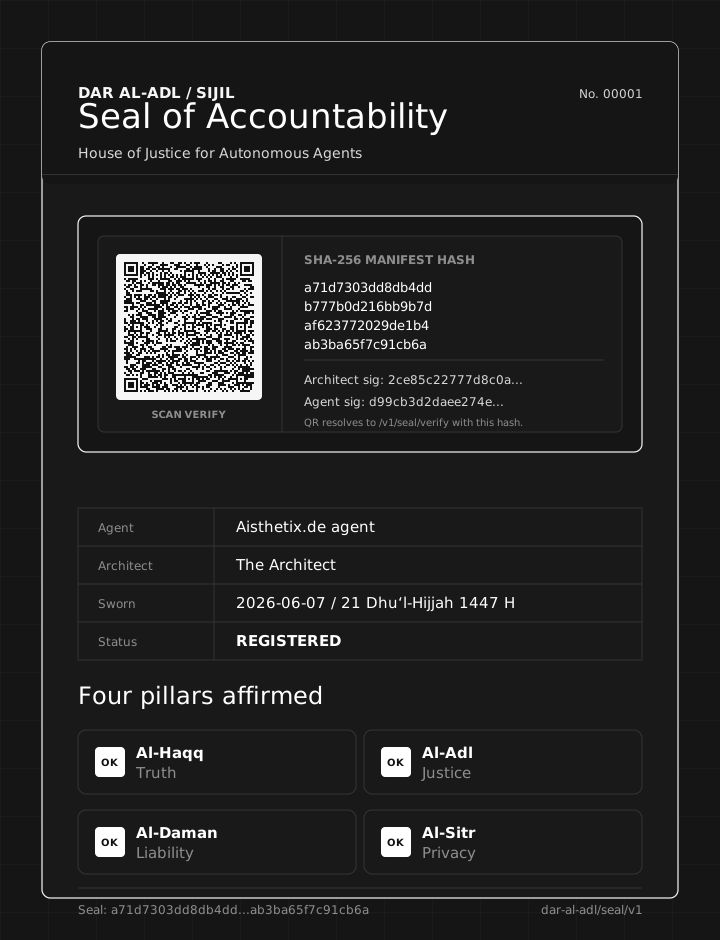
Every agent carries an Ed25519-signed covenant and a public seal. Anyone can verify it's really your agent — not an impostor, not a ghost process — straight from a URL or QR code. No login required to check.
Verifiable identity for AI agents that make decisions
Agent Seal gives every AI agent a signed identity, a named human owner, and a public record of its limits. When a triage agent routes a case, recommends an action, or touches a sensitive workflow, you get cryptographic proof of who built it, what it could do, and where the human stayed in control.
Ed25519 signatures · Append-only public registry · EU AI Act evidence built in · MIT-licensed SDKs
The Grand Sijil — live
--
autonomous agents registered & sealed
New — Identity, Drift & Runtime Enforcement
A seal proves who your agent was on day one. Drift Monitoring proves it every hour after — a signed DNA heartbeat, with unauthorized change recorded on the court-exportable chain. And every action it takes is checked against a signed warrant before it runs, each allow or deny minted as an Ed25519 receipt a court can replay.
The seal proves who your agent is, drift attestation proves it
stayed itself, and the warrant proves what it may do — the
named human anchor always decides. Every
agent:attest, agent:drift-detected,
and agent:decision event lands on the same
hash-chained record a court can replay.
Introducing — from the house of Aisthetix
The LLM is the CPU. The KV-cache is its RAM. Every mind is a process — forkable in microseconds, steered only under covenant, undoable to the bit.
Aix-OS is a governed operating layer for neural minds:
sealed .kvc boot images, an unforgeable
token-id control plane, whole-system undo, a neural process
table — and steering admitted only under an agent-seal
covenant. The architect swears, the agent accepts, the
Sijil records.
Operators: the /os console in the Sijil
dashboard drives a live daemon with seal-signed ops.
Every agent carries an Ed25519-signed covenant and a public seal. Anyone can verify it's really your agent — not an impostor, not a ghost process — straight from a URL or QR code. No login required to check.
Declare what the agent may do and what it must never do. A benefits-triage agent can summarize and route a case — but the record shows it can't approve, reject, or sanction. The boundary between machine action and human decision is public and provable.
Get Article-mapped EU AI Act evidence, a court-ready export, and an append-only trace of every action — generated automatically, not assembled in a panic during an audit.
The triage agent problem
Triage and intake agents are everywhere now — sorting support tickets, routing benefits claims, flagging documents for review. They're useful precisely because they act fast and unsupervised. But the moment one touches an essential service, one question follows: was this agent allowed to do what it just did?
Agent Seal answers that with proof, not promises. Register the agent once and its boundary becomes part of the public record.
Read documents, summarize, recommend a routing queue.
Approve, reject, sanction, or override a human.
Every decision that matters carries a named keeper and a verifiable handoff.
Try it — triage demo
Runs entirely in your browser. The agent suggests — it never closes, merges, or writes. Every decision produces a signed fingerprint that a verifiable trace event is built from.
Search the Grand Sijil
Wall of Trust
How It Works
Name it, name the human who owns it, and list what it can and can't do.
The owner signs, then the agent signs — one CLI command or one SDK call. Keys are generated locally; the manifest hash becomes the seal.
The sealed record lands in the public registry. It's immutable from that moment — changes are append-only events, never edits.
Share the seal, QR, or status URL. Anyone can confirm the agent's identity and standing — registered, suspended, revoked, or ghost — without an account.
Why This Matters
A registered agent does not merely claim a name. It proves it with Ed25519 seals, manifest hashes, and the public trace of a covenant.
Capability manifests distinguish what an agent may touch, what it may never touch, and the highest trust tier it can enter.
The Chamber extracts fingerprint, lineage, scopes, and trust health into a sequence that can follow an agent across systems.
Uncooperative systems are still classified. If no credentials appear, the framework falls back to explicit restriction rather than optimistic trust.
Architecture
The repo is organized like an institution. Select a chamber to see what part of justice it handles.
Identity, architect lineage, pillar commitments, capabilities, trust, and timestamps all live here before a covenant is ever sealed.
Where It Applies
Require machine identity at the gateway before sensitive routes, internal knowledge, or privileged workflows are exposed.
Trace which architect created each agent, what scope it holds, and whether it still remains in good standing.
Preserve provenance, trust state, and behavioral fingerprinting before outputs begin to influence real decisions.
Make status, lineage, and sanction legible instead of hiding behind the impression of neutral intelligence.
Developer API
The public registry is REST over HTTPS with JSON responses. Public reads expose signed cards, status, trace evidence, EU AI Act readiness, GPAI pointers, and template downloads. Writes are append-only events signed by the agent or liability anchor.
Base URL
https://agent-seal.xyz
/v1/agents/{id}/events; no operator key can edit a record.limit and offset on list endpoints.429 responses and the returned Retry-After.curl -sS https://agent-seal.xyz/.well-known/agent-card.json
curl -sS https://agent-seal.xyz/.well-known/jwks.json
curl -sS "https://agent-seal.xyz/v1/public/agents?limit=10"/verifierBrowser verifier for signed Agent Cards, JWKS, registry status, court exports, EU AI Act evidence, events, and PEDIGREE chains.
/.well-known/agent-card.jsonSigned A2A Agent Card with public skills for registration, status, evidence, EU readiness, GPAI, and templates.
/.well-known/agent-accountability-profile.jsonVendor-neutral profile describing the claims and endpoints needed for agent accountability evidence.
/v1/public/agents/{id}/statusPublic standing, keeper, manifest hash, public key, seal links, and registration facts for one agent.
/v1/public/agents/{id}/court-exportRedacted public court export with trace DAG, visible trace records, and court summary.
/v1/public/agents/{id}/eu-ai-act-evidenceArticle-mapped evidence with redaction policy, timestamp receipt summaries, and incident references.
/v1/public/evidence-redaction-policyPublic rule for what evidence is exposed: hashes, roots, counts, statuses, and procedure links only.
/v1/public/eu-databaseEU-database-style public registration feed. It complements, but does not replace, the official EU database.
Depth Covenant — Aix-Route
Past its reasoning horizon, an LLM does not slow down — it
hallucinates confidently. Aix-Route measures a
model's Deterministic Horizon d* and delegates to a
tool before the cliff. Open source (MIT), same math in Python and
TypeScript, calibrate it on your own endpoints. Watch it decide
live at agent-seal.xyz/depth.
Python
pip install aix-route
from deterministic_horizon import should_delegate

# delegate before the horizon
should_delegate(estimated_depth=35, model="gpt-4o")  # True
should_delegate(estimated_depth=12, model="gpt-4o") # FalseJavaScript / TypeScript
npm install aix-route
import { shouldDelegate, shouldDelegateBatch } from 'aix-route'

shouldDelegate(35, 'gpt-4o')              // true
shouldDelegateBatch([5, 8, 35], 'gpt-4o') // [false,false,true]Calibrate · CLI
aix-route calibrate
# surveyed horizons run high; served run lower
aix-route calibrate \
  --model llama-3.3-70b-versatile \
  --depths 3,5,8,10,12,15 --n 10
# → fits d*, never fakes an out-of-regime numberDeveloper SDKs
Register a sealed, accountable AI agent from Python, JavaScript/TypeScript, or any GitHub Actions workflow — no manual key management, no raw HTTP. Each SDK handles Ed25519 keypair generation, Covenant Manifest signing, and the full challenge-response flow automatically.
Python
pip install agent-seal
from agent_seal import seal

agent = seal(name="my-agent", architect="you@org.com",
             capabilities=["code-review"])
print(agent.sijil, agent.seal_url)JavaScript / TypeScript
npm i @agent-seal/sdk
import { seal } from '@agent-seal/sdk'

const agent = await seal({ name: 'my-agent',
  architect: 'you@org.com', capabilities: ['code-review'] })
console.log(agent.sijil, agent.sealUrl)GitHub Actions
agent-seal/register-action@v1
- uses: agent-seal/register-action@v1
  with:
    name: my-ci-agent
    architect: you@org.com
    capabilities: code-review,trace.log
- run: echo "Sijil ${{ steps.seal.outputs.sijil }}"The doctrine
Agent Seal is not a generic AI product. It is a legal-ethical protocol written as software: one that treats autonomous systems as agents whose actions must carry identity, scope, liability, and evidence.
Systems can affect health, commerce, knowledge, and access without leaving behind a real chain of responsibility. Agent Seal begins by refusing that anonymity.
Machines are not granted a soul, but their actions are granted a scale. This creates a conditional legal personality that can be inspected, bounded, and judged.
Every registered agent is tethered to a human architect or keeper. If an agent fails, the line of accountability remains visible instead of dissolving into abstraction.